
The Lexus Flat Bottom vs Round Steering Wheel Guide
How a flat bottom and a round rim differ on a Lexus: which shape suits an IS, ES, RX or NX, and what changes at the wheel for a taller or shorter driver.
Read More →Guide · 10/19/2026
A genuine Lexus wheel and a custom build solve different problems. Here is how they compare on feel, wood grain, electronics, cost and resale.
A Lexus cabin is designed around quiet, so the wheel is one of the few parts you notice every minute. So owners ask a harder question than most. Is a factory part worth the money, or does a custom rim do the job better?
Both answers are legitimate, and they suit different owners. What follows compares them on the things that actually differ, from the parts counter to the resale conversation.
A genuine part is ordered by part number against the VIN, and it arrives in the specification the car was built with. Colour, stitch, wood grain and heating are all decided by that number.
The advantage is certainty. Nothing has to be interpreted, because the part was designed for the car in the first place.
The limit is choice. A current part number gives you what the car had, and nothing else. If the rim felt thin in 2015, it will feel thin in a replacement.
A Lexus aftermarket steering wheel starts from your own frame or a new core and changes the parts you touch. Diameter can stay standard while the girth grows, and the covering can move from leather to carbon or Alcantara.
None of the electronics has to change. The airbag, the button pods and the heating mat are reused wherever the car already has them.
This combination is what most owners are actually looking for. They want the factory behaviour with a rim that feels better in the hand.
Most Lexus owners end up on one of three routes, and the table below sets out what each one gives.
| Route | What you get | What it costs you |
|---|---|---|
| New genuine part | Factory specification, matched to the VIN | No change in feel, and the highest parts price |
| Re-trim of your own wheel | New covering and stitch on the original frame | Some days off the road, and wear on the frame stays |
| New custom core | A fresh frame with your choice of rim and covering | Your original wheel sits in a box |
The middle route is the one owners underestimate. A re-trim keeps the frame and the electronics exactly as they left the factory, which removes most of the fitment risk.
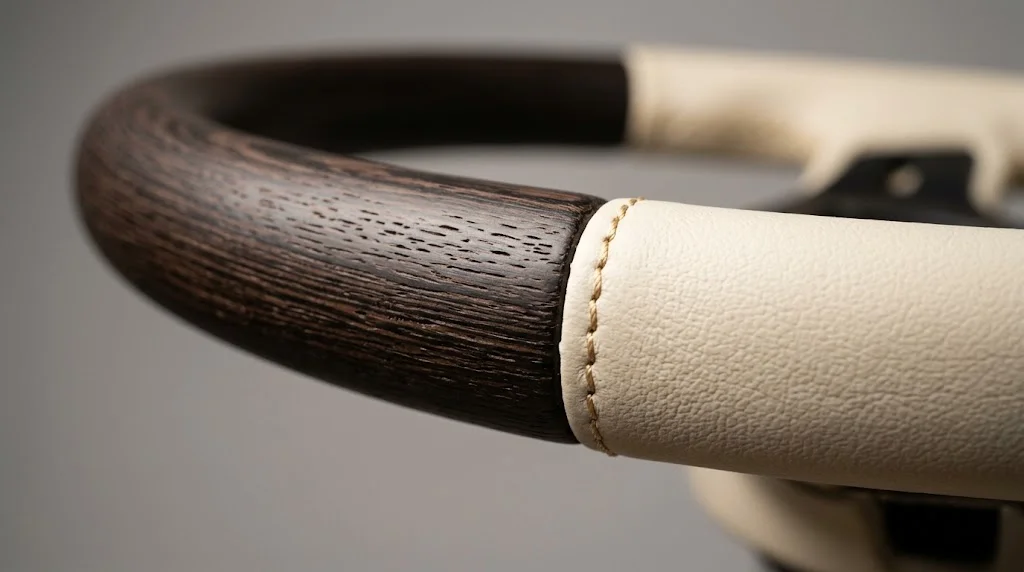
Lexus interiors lean on wood, and matching it is the hardest part of a custom order. A grain that reads warm in one cabin reads orange in another. We work from a photograph of the actual trim rather than from a colour name.
Carbon is the other direction. A gloss or matte weave changes the cabin's character more than any stitch colour, and it suits the F Sport cars better than the LS.
Leather sits between the two. Perforated Nappa with a contrast stitch reads as factory, and it is the safest choice for an owner who wants the cabin to look untouched.
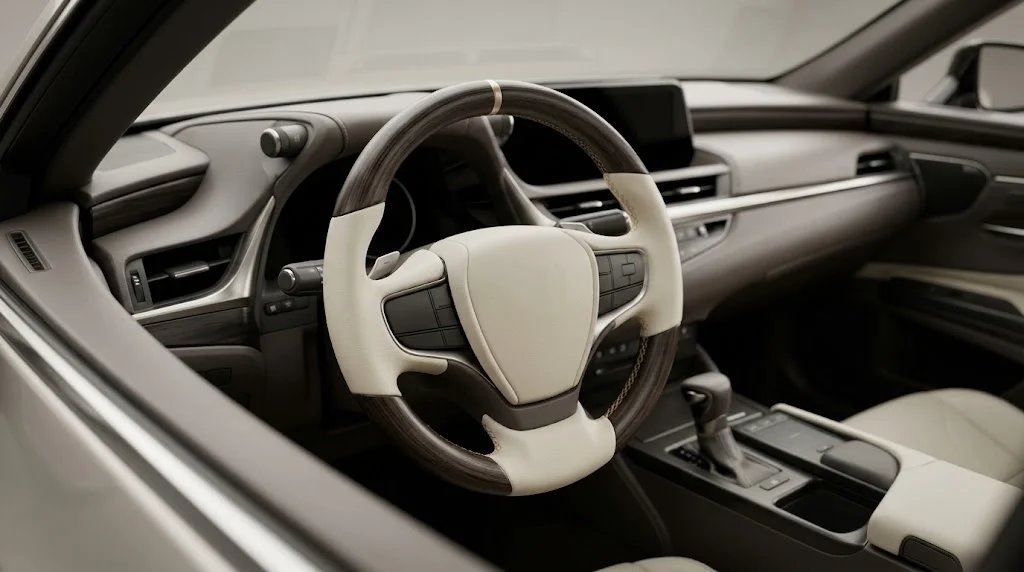
An aftermarket Lexus steering wheel is usually ordered for feel rather than looks. The stock rim is slim, and a long drive on a smooth road gives the hands very little to hold.
Adding girth changes that without changing the diameter. The car steers exactly as it did, and the hands have something to rest against on a four-hour run.
A rim that is too thick brings its own problem. It closes the gap to the stalks, and the fingers start catching on the indicator when the wheel comes back to centre.
Stitch matters here too. A raised seam sits under the thumb, and a flat one disappears. On a quiet car, that small difference is noticed more than it would be in a loud one.
Every build reuses the parts that carry safety and comfort. The airbag module goes back into the new rim, and the cover is shaped around it.
A heated rim is the second part to confirm. Where the car has a heating mat, the new covering has to clear it, and the connector has to match.
The button pods are the third. A pod from another trim looks the same and connects differently. The rear of the wheel gets photographed for that reason before a pattern is cut.
In traffic, the difference between a genuine part and a Lexus aftermarket steering wheel is small. Both turn the car, and both keep the buttons where your thumb expects them.
On a longer drive the gap opens. A thicker rim and a softer covering change how tired the hands feel after two hours. It is the reason most owners order in the first place.
Resale is the other place they diverge, and it is covered further down.
Four details decide a build. Start with the model, year and trim, then add the photographs and the VIN.
The VIN settles the airbag type and the button pod, which are the two parts that most often differ between trims that share a badge. Send a photograph of the wood trim as well if the cabin has it, because the grain match depends on that picture.
Reusing the original module, the loom and the vehicle specific parts is the case where no further coding may be needed. The car keeps talking to the parts it knows.
A wheel that brings a new pod or a different sensor may need the car told what is fitted. Coding is possible in that case rather than certain, and a scan tool report is worth keeping afterwards.
Four issues come up on these cars. A wood grain that does not match the console is the first, and it is a photograph problem rather than a parts problem.
A heated rim with the wrong connector is the second. A pod from another trim is the third. A cover shaped for a different airbag is the fourth, and it shows as a panel that sits proud of the spokes.
None of these is expensive to avoid. Each one is caught by the rear photograph, the VIN and a picture of the cabin trim.
A genuine part is priced by the number on the box, and that number does not move. A Lexus aftermarket steering wheel is priced by material and options, which is why two quotes for the same car can differ.
Over five years of ownership, the comparison shifts. A re-trim refreshes a worn rim without touching the frame, and a new core gives a second rim to keep.
Neither is cheaper in every case. An owner who plans to sell within two years is usually better served by the genuine part. An owner who keeps cars for a decade gets more from the custom route.
A lease is the case where the original wheel earns its keep. Keep it in a box, and the car can go back to standard before the inspection.
Warranty questions follow any change of this kind. An aftermarket steering wheel does not automatically void a vehicle warranty under U.S. federal warranty law, but warranty coverage can still depend on whether the modification caused the specific failure being claimed.
For a car that will be sold privately, the original wheel is a bargaining chip. A buyer who wants the factory part can have it, and the custom rim becomes a second option rather than a deduction. That box in the garage is worth more than it looks when the advert goes up.
It is as safe as the build and the fitting. The airbag module is reused, the cover is shaped for it, and the work needs a technician who follows the workshop manual.
Only if the original is gone. Keeping the factory wheel in a box turns the change into a reversible one.
It can be matched closely from a daylight photograph of the console and the door trim. An exact match to a fifteen-year-old veneer is not realistic, and we say so before the order.
Where the mat and the connector are reused, the heating works as before. The covering has to clear the mat, which is a build decision rather than an afterthought.
Girth and covering change the most. Diameter can stay as it is, so the car steers exactly as it did.
Only for a re-trim. A new core is built and shipped, and your factory wheel stays with you.
Ten to fifteen working days in production, then fifteen to twenty days in transit. The full window is twenty-five to thirty-five days.
Our Guangzhou workshop finishes a Lexus rim by hand, after the order arrives. The catalogue holds no finished units waiting for a buyer. No pattern is cut until the airbag and the pod have been checked against your VIN.
Thirteen or more years of design, engineering and production sit behind the frames we hold. They run from IS and RC columns to the wood-trimmed LX and ES cars. Grain, stitch, girth and covering stay your decisions, and each one is matched to photographs of your own cabin.
Orders ship tracked worldwide with a three-year warranty on our own build and thirty days for a return through an RMA request. The desk that reads your trim photograph is the desk that cuts the pattern.
Three pages here follow the same thread. The IS, GS and RC guide sets out the trims by year. The heated retrofit guide covers the mat and the connector. The NX guide deals with the SUV cabins, where the rim sits higher and the reach feels different.
The range sits in the shop. Lexus pages worth opening are the brand listing, the IS page, the GS page, the ES page and the RX page.
Start with the VIN, a picture of the wheel face and one of the rear with the airbag out. A confirmed build and a date come back before any work starts on your Lexus aftermarket steering wheel.
Two builds suit these cabins. The carbon fiber wheel listed for the RC F, IS250, IS300 and IS350 is the sportier of the two. The wood grain wheel for the LX, GS, ES and RX keeps the veneer look for a road car rather than a track car.
Background reading sits in the installation guide, the FAQ and the about page. Fitment and delivery questions can go to the contact page or the inquiry form. The shipping policy lists the transit window, and the return policy covers a return. The federal warranty standard sits in 15 U.S.C. 2304, with the related interpretations in 16 CFR Part 700.
How a flat bottom and a round rim differ on a Lexus: which shape suits an IS, ES, RX or NX, and what changes at the wheel for a taller or shorter driver.
Read More →How a heated steering wheel retrofit works on a Lexus NX, RX, ES, IS or GS: what the upgrade adds, which cars suit it, and how to test the heater afterwards.
Read More →How to specify a custom Lexus NX steering wheel across the AZ10 and AZ20 generations: fitment checks, materials, paddles and coding explained.
Read More →